
Challenge
From friction to delight: uplifting the games' identity experience for users while balancing design and engineering constraints around autogenerating user names
Design + content systems, interaction design, behavioral design, UX research
Business Need
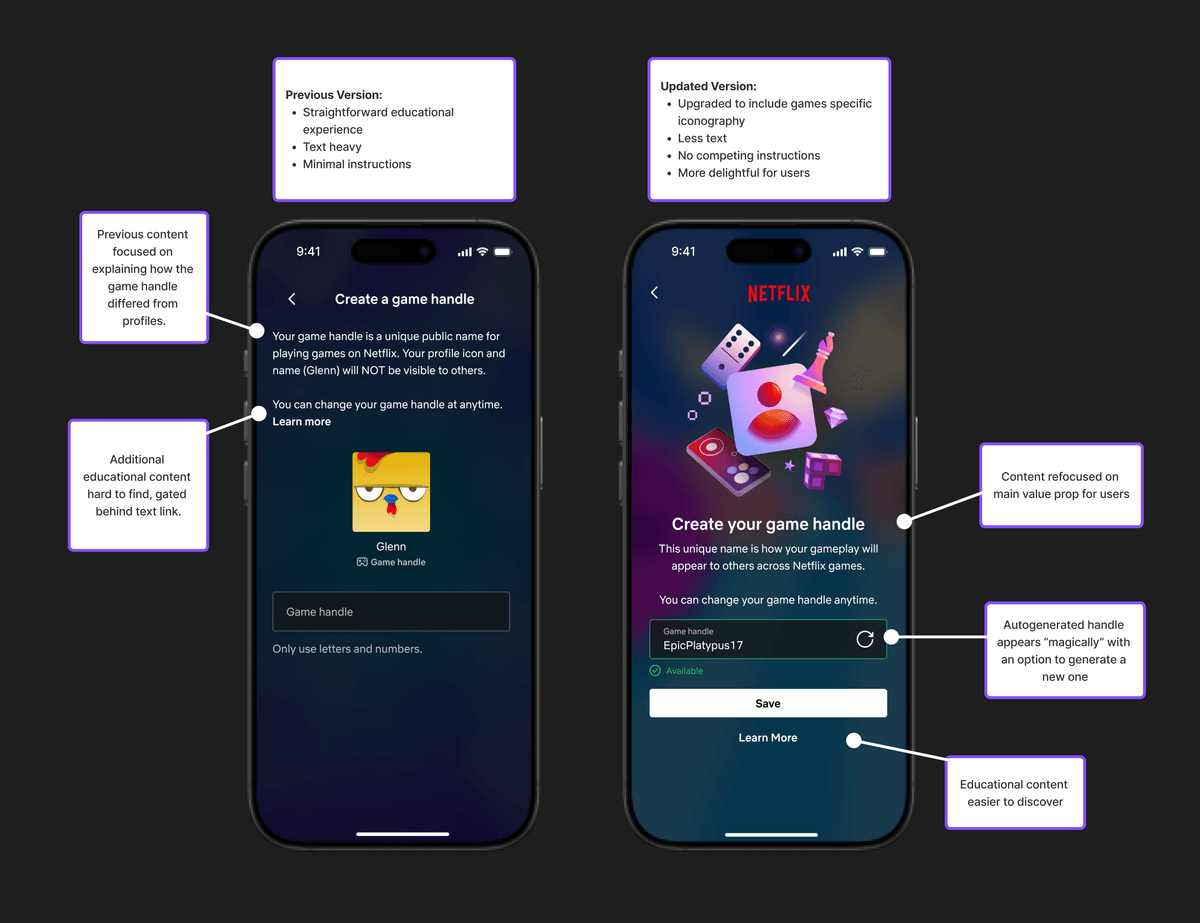
Requiring users to manually create a game handle created real friction — research showed significant drop-off when mobile game users hit a handle-creation step before they could start playing. The experience also felt like a chore rather than something users wanted to engage with.
Proposed Outcome
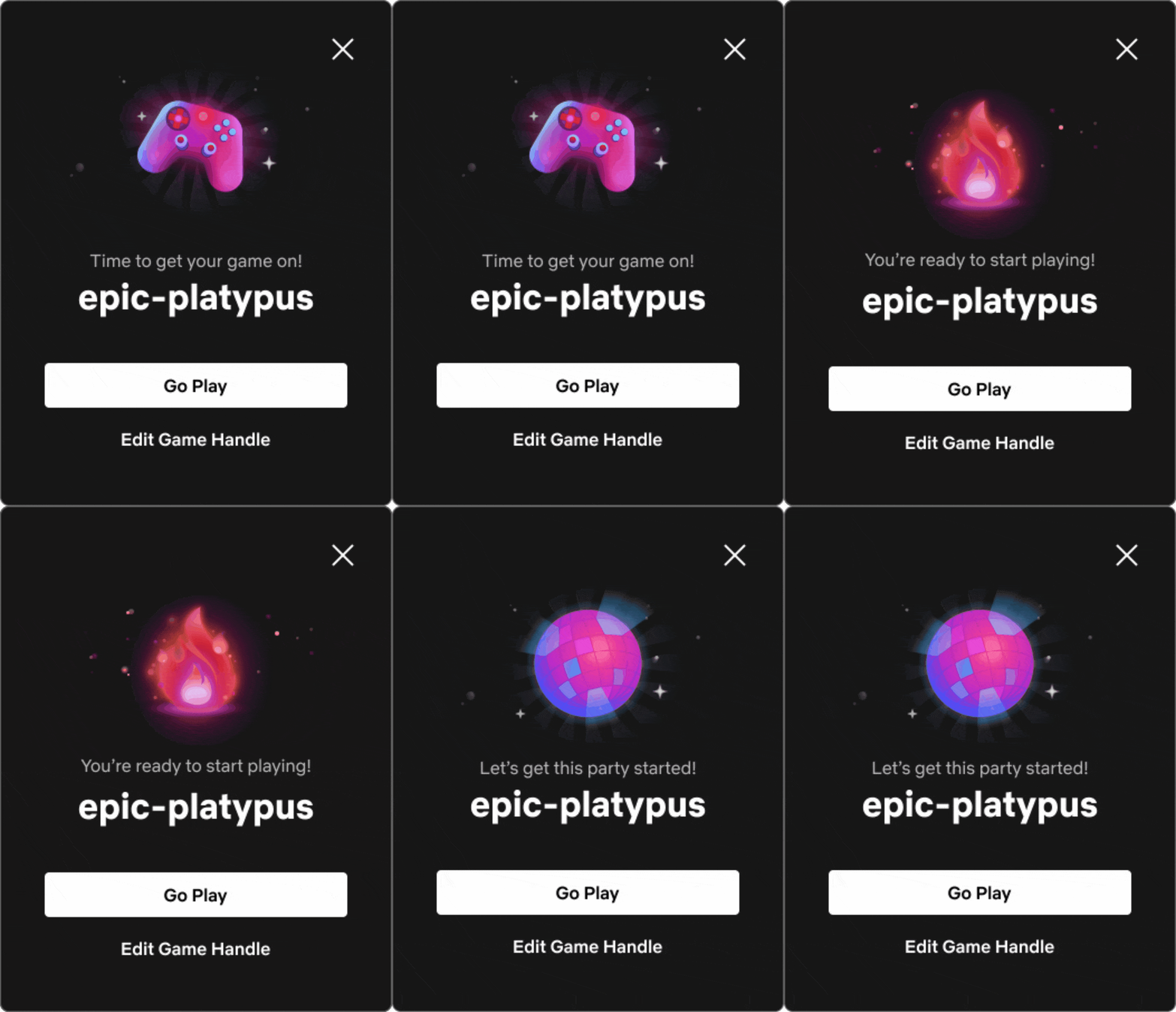
Remove the friction entirely by autogenerating a handle for every user upon game start, while still making the handle feel personal, fun, and worth keeping, so users would get into gameplay faster without losing the sense of identity a handle was meant to provide.
Context
- Manual handle entry was adding an unnecessary step between opening a game and playing it, at a point in the funnel where users were most likely to abandon the experience
- Improving the step meant the system needed to generate handles automatically, at scale, while keeping each suggestion unique and worth keeping rather than randomized
- Generated handles needed to clear content moderation before ever reaching a user — showing someone a handle and then revoking it would undermine the experience entirely
- This was a new concept for most Netflix users, who were used to private, single streaming profiles rather than a public, gaming-specific identity
Solution
Moved from a typed-handle experience to a fully autogenerated one, validated through targeted qualitative research and built in close partnership with engineering and Netflix's moderation service.
Built it by:
- Conducting targeted qualitative research with users, testing three content directions for how to frame and introduce the handle feature: a social angle, a gameplay angle, and an identity-focused "you" angle
- Identifying the "you" angle as the clear winner — research showed users responded most to the idea of a unique identity that represented them specifically, visible across all Netflix games
- Partnering with engineering to build the word bank powering the autogenerated handles, balancing two competing goals: maximizing the number of unique possible combinations while keeping the format simple and appealing
- Pushing for a 3-number maximum in the handle format (rather than allowing longer numeric strings), prioritizing a cleaner, more memorable user experience over maximizing raw combinatorial output
- Submitting every word in the word bank for individual moderation review, removing any flagged as harmful, across multiple passes as new words were added
- Ensuring the moderation service validated full word combinations, not just individual words, before any handle was ever shown to a user, so no one would see a handle only to have it revoked
Outcome
- Eliminated a major friction point in the mobile game onboarding flow
- Identity-focused framing was adopted across handle-related content, onboarding copy, and supporting screens
- Word bank generated thousands of unique handle combinations across four formats (adjective + noun + 1-3 numbers, noun + noun + 1-3 numbers)
- Zero instances of users seeing a handle that was later flagged or revoked, due to pre-validation through moderation
- Adoption of autogenerated handle flows were also scoped to upcoming cloud games, where particular games would require a handle prior to game start as well.
What I'd Revisit
The research that shaped the "you" framing was qualitative and directional rather than a true A/B test with quantitative drop-off data post-launch. If revisiting, I'd want to pair the qualitative research with a true experiment post-launch — testing the "you" framing against the social and gameplay directions live, with real adoption and retention data, to validate the decision at scale rather than relying on stated preference alone.